Defense Manufacturing Readiness: Preparing for Peace, Steady, and Surge with ARMOR
October 9, 2026Meeting today's production targets does not necessarily mean a manufacturing facility is prepared for tomorrow's demands.
For manufacturers supporting the defense industrial base, production requirements can change significantly depending on program schedules, supply chain conditions, and defense priorities. A facility operating efficiently at its current production rate may still face equipment, workforce, or capacity limitations when demand increases.
Understanding these constraints before they affect production is essential. A structured manufacturing readiness assessment helps manufacturers evaluate their capabilities, identify operational risks, and prepare for changing production requirements.
What Is Defense Manufacturing Readiness?
Manufacturing readiness refers to an organization's ability to meet production requirements while maintaining control over quality, capacity, resources, and delivery performance.
For defense manufacturers, readiness extends beyond individual equipment capabilities. It requires coordination across production operations, workforce availability, supply chain performance, maintenance, and quality management.
A facility may have sufficient machining capacity to meet current demand but lack the inspection resources needed to support higher production volumes. Similarly, increasing equipment utilization may reduce available maintenance time, creating reliability concerns.
These dependencies make readiness a system-wide consideration.
Understanding Peace, Steady, and Surge Operations
Defense manufacturing requirements are not always consistent. Changes in demand can place different pressures on equipment, personnel, suppliers, and production systems.
DSI's ARMOR Defense Industrial Base Readiness Tool evaluates manufacturing capabilities across three standard operating conditions, Peace, Steady, and Surge. Manufacturers can also select an Other / User Defined condition to describe their current operating environment.
Peace State: Maintaining Manufacturing Capability
Peace State represents low-demand, sustainment-focused operations with available production capacity. The emphasis is on maintaining manufacturing capabilities, developing workforce skills, and preserving the resources needed for future production.
While lower demand may provide opportunities for maintenance, training, and process improvements, available capacity does not automatically indicate readiness for increased production.
Steady State: Sustaining Planned Production
Steady State represents normal, sustained production at planned rates. Workforce resources, equipment capacity, and supply chain performance must remain balanced to consistently meet program requirements.
Even when a facility achieves its planned output, underlying constraints may limit its ability to sustain performance or respond to changing conditions.
Surge State: Responding to Maximum Demand
Surge State represents crisis-level production demand, potentially reaching approximately three to five times Steady State requirements within ARMOR's assessment framework.
Supporting this level of production may require additional shifts, expanded supplier capacity, increased equipment utilization, or accelerated workforce training.
However, increasing resources without addressing existing bottlenecks can create additional operational challenges. Expanding assembly capacity, for example, provides limited benefit if upstream fabrication or downstream inspection cannot support the higher production rate.
Surge readiness requires understanding how the entire manufacturing system performs under increased demand while maintaining quality, safety, and delivery commitments.

Why Current Production Performance Does Not Guarantee Readiness
Manufacturers can consistently meet production targets while operating near their practical capacity limits.
Equipment may be running at high utilization, production schedules may depend on overtime, or critical processes may rely on a limited number of qualified employees. These conditions can remain manageable until production requirements change.
Several operational constraints can affect readiness:
Production capacity: Bottlenecks, equipment availability, and process variability can limit achievable throughput.
Workforce capabilities: Staffing shortages, specialized skills, and training requirements can restrict production flexibility.
Supply chain resilience: Supplier capacity, material availability, and lead times can affect production continuity.
Quality and facility constraints: Inspection capacity, material flow, utilities, and available floor space can limit expansion.
These challenges rarely operate independently. Increasing output in one area may shift the bottleneck to another process.
Identifying these relationships helps manufacturers make more informed decisions about production planning, engineering improvements, and capital investments.
Evaluating Manufacturing Readiness and Transition Risks
A manufacturing readiness assessment provides a structured approach to understanding whether existing capabilities can support current and future production requirements.
Effective assessments consider more than theoretical equipment capacity. Actual cycle times, labor availability, equipment reliability, material flow, and supporting processes all influence achievable production output.
Manufacturers must also distinguish between demonstrated performance and projected capability. A facility's current production results provide valuable information, but they do not necessarily establish its ability to operate at substantially higher volumes.
Engineering analysis can help evaluate these limitations. Capacity studies, process analysis, and manufacturing simulation allow organizations to examine production scenarios and understand how proposed changes may affect overall system performance.
The objective is to identify constraints early and prioritize improvements based on operational requirements and transition risks.
How DSI's ARMOR Assessment Supports Defense Manufacturing Readiness
Design Systems, Inc. developed ARMOR, a Defense Industrial Base Readiness Tool, to help manufacturers evaluate their operational capabilities and identify potential barriers to increased production.
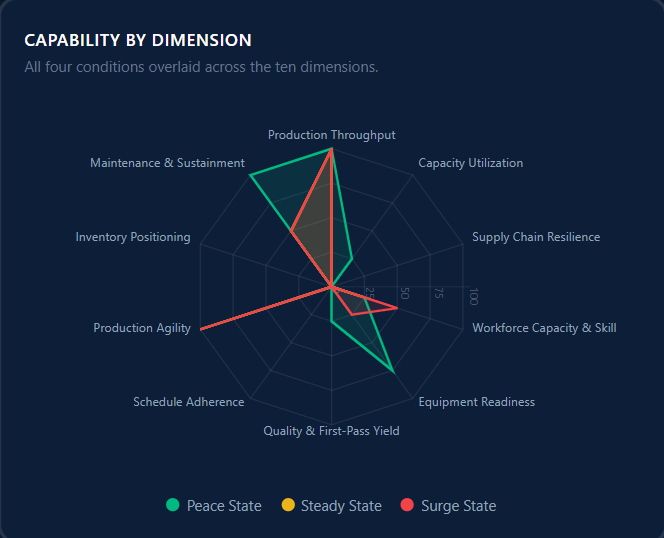
ARMOR assesses 10 critical manufacturing dimensions, including production throughput, capacity utilization, supply chain resilience, workforce capabilities, equipment readiness, quality performance, and production agility.
The assessment is built around four questions: How is the system performing today? What will be required at the next operating condition? How ready is the system to meet that requirement? What prevents a successful transition?
Measuring Readiness Beyond Current Performance
ARMOR distinguishes actual operating performance from future-state readiness.
For the current operating condition, manufacturers assess actual performance and classify the supporting evidence. For future conditions, they define production requirements and evaluate their readiness to meet those requirements.
Each dimension is evaluated using a five-level readiness scale, supported by evidence classifications and confidence ratings. This helps distinguish capabilities supported by measured performance from those based on modeling, previous demonstrations, or estimates.
Identifying Constraints and Prioritizing Improvements
ARMOR also evaluates transition risks, including equipment capacity, supplier lead times, workforce shortages, training requirements, facility limitations, material availability, and maintenance constraints.
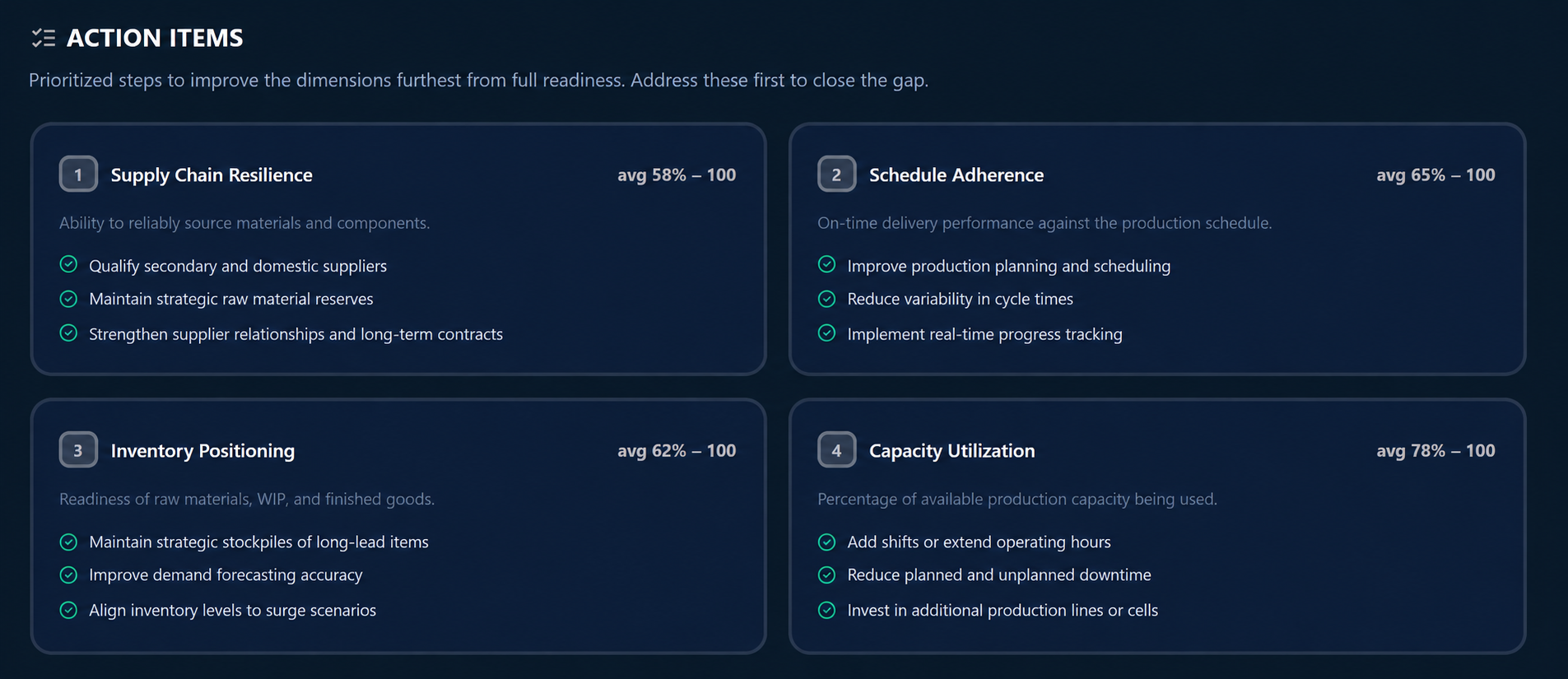
After completing the assessment, manufacturers receive a readiness report with visual comparisons across operating conditions, identified capability gaps, transition risks, and prioritized improvement actions.
These findings provide a starting point for further engineering evaluation and improvement planning.
For manufacturers requiring additional support, DSI offers manufacturing engineering, simulation, facility planning, and implementation expertise to evaluate and address operational constraints.
Preparing for Changing Defense Production Requirements
Manufacturing readiness is not determined solely by today's production results. It depends on whether equipment, personnel, suppliers, and supporting processes can meet the requirements of future operating conditions.
Evaluating these capabilities before demand increases helps manufacturers identify risks, prioritize improvements, and make more informed production decisions.
Since 1983, Design Systems, Inc. has supported manufacturers with practical engineering solutions designed to improve operational performance and support implementation.
Assess your facility's readiness for changing production demands.
Begin the ARMOR Manufacturing Readiness Assessment
Learn more about DSI's Aerospace & Defense Engineering Solutions.